
What happens when the person who promised eternal life lies dead in your arms?
Mary holds her son. He is dead.
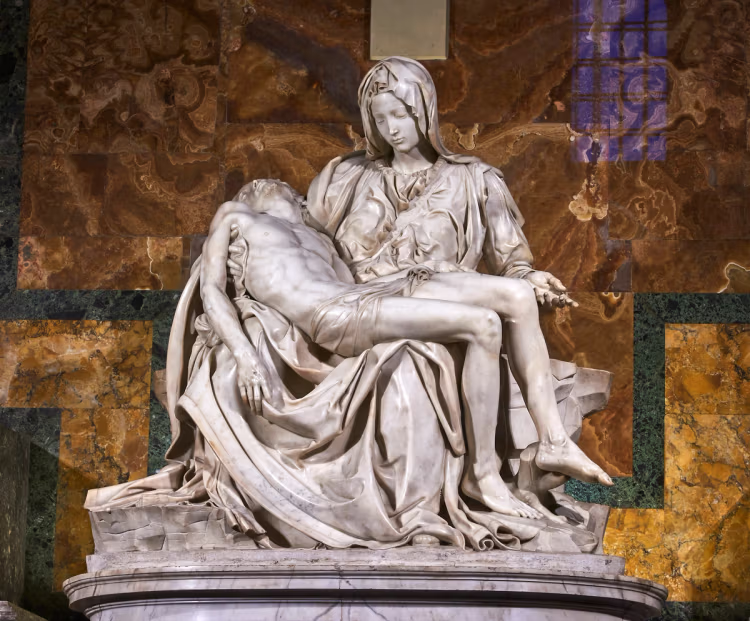
Look at Michelangelo’s Pietà for a moment. Look at the way Jesus rests across his mother’s lap. His head falls gently to one side. His arm hangs loose. There is no movement, no response, no sign of life.
And look at Mary. She holds the dead son she loves so deeply.
This is not just a mother mourning her child. This is Mary holding Jesus Christ, the man she had watched grow, the one who spoke of God’s kingdom and promised Eternal Life. The one Christians believe came to save humanity and open the way to God.
Now he lies dead before her.
What are we to make of this moment?
Michelangelo could have shown us the risen Christ, triumphant over death. Instead, he takes us to a moment when all seems lost. There is no empty tomb, no angel announcing the Resurrection, no glimpse of what is to come. There is only a mother, her dead son and a grief we can recognise, even if we cannot imagine its full depth.
Yet we know something Mary could not yet see. The Christian story does not end here.
And that is where this extraordinary sculpture begins to speak to us.
When the promise seems lost
To understand the weight of Mary’s grief, we must remember who Jesus was and what he had promised.
His life was not an ordinary life that ended in an ordinary death. Jesus came to fulfil God’s promises, to reconcile humanity with God and to offer the gift of Eternal Life.
“”I am the resurrection and the life.”
John 11:25
Think about those words.
Jesus did not simply tell people that life might continue after death. He called people to trust him.
And now he is dead.
We know what happened after. But try, for a moment, not to rush ahead. Stay with Mary. The Gospels do not tell us exactly what she was thinking or how much she understood at this moment. We cannot even imagine the questions that such a loss might bring.
Had everything she had witnessed led to this? What had become of the Promises? How could the one who spoke of life have met such a cruel death?
These are our questions, too, whenever life takes a turn we cannot understand.
What happens to faith then?
It is easy to believe in hope when life is kind to us. It is harder when we are standing among the ruins of what we thought would be.
Love still hurts. Loss still wounds. And, in our darkest moments, we cannot see how God’s promises and our suffering can possibly belong to the same story.
What Michelangelo asks us to see
Michelangelo completed the Pietà in 1499, when he was still in his early twenties. He carved it from a single block of Carrara marble. Today, it stands in St. Peter’s Basilica in the Vatican.
Its beauty is immediately striking. But the longer we look, the more we notice the tenderness.
Christ’s body rests heavily across Mary’s lap. She supports him, but she cannot change what has happened. Her hand reaches towards him in a gesture that seems both protective and helpless.
There is something painfully human in that gesture. When someone we love is suffering, we want to do something. We want to take away the pain, to protect them, to make things right. And sometimes all we can do is stay beside them.
Mary can do no more than hold her son.
Michelangelo does not cover this helplessness with drama. He gives us stillness. There is no movement to distract us from the reality of death. We are left to look at the body and the mother who holds it.
And notice what he does not show us.
He does not show Christ rising from the tomb. He does not show Mary receiving the news that her son is alive. The sculpture stops at the moment when death seems to have won.
We cannot know every thought Michelangelo wished to convey. But his choice of this moment leaves us with something powerful to consider. Before we celebrate the Resurrection, we must face the death that makes it so extraordinary.
The death of a body is painful. The eternity of a soul is God’s promise that death will not have the final word.
The marble shows us the first truth. Our faith points us towards the second.
The love that death could not end
There is another reason Mary’s presence matters so deeply.
She is holding her dead child.
Michelangelo gives us a way into the crucifixion through pure love.
The crucifixion is not just a simple story about suffering. God entered the very suffering and death. Jesus gave himself for humanity, and His death was not the final chapter.
Of course, the pain and death matter because without them, we never understand the depth of the Christian claim that Christ rose again.
The Resurrection does not mean that the cross never happened. It means that the cross did not have the final word.
For someone who is grieving, these words will never take away the pain and sorrow. They bring something different: the possibility of hope even when life has brought us to a place we never wanted to be.
And perhaps that is why the Pietà still touches so many people. It does not turn away from the pain. It lets us look at it, and then invites us to remember that our existence reaches beyond what we can see.
What endures?
Michelangelo’s masterpiece has survived for more than five centuries. Generations have stood before it, each bringing their own questions, losses and hopes.
The marble remains. The grief it portrays still feels familiar.
But perhaps what endures most is the question the sculpture leaves with us.
What happens when hope seems to have died? What do we hold on to when the person we love is gone, when the answers do not come, when we cannot see a way forward?
Mary holds Jesus in the stillness after the crucifixion. She cannot yet see the empty tomb. She cannot see the moment when the story will turn towards Resurrection.
We can.
For us, that changes everything. The body in Mary’s arms is the body of the one who died, but it is also the body of the one who rose again. The promise of Eternal Life was not defeated by the grave.
This is the reason why Michelangelo’s Pietà is more than a beautiful sculpture.Face the hardest of truths when standing at the edge of its greatest hope.
We see a mother who cannot save her son from death. We see a son whose suffering seems to have brought everything to an end.
But we know that death will not have the final word.
The marble holds the moment. Our Faith tells us what comes after it.
SOURCES
St Peter’s Basilica, Vatican, The Pietà of Saint Peter’s.
John 11:25–26, Jesus declares that he is the resurrection and the life.
John 19:25–30, Mary at the cross and the death of Jesus.
Vatican Museums, The Three Pietàs Sculpted by Michelangelo.
Editorial note: This article offers a Christian reflection on Michelangelo’s Pietà, exploring its artistic significance and the themes of grief, sacrifice, faith and the hope of the Resurrection. Biblical references are drawn from Scripture, while reflections on Mary’s experience and the meaning of the sculpture are presented as interpretation rather than historical fact. The article does not claim to establish Michelangelo’s personal intentions beyond documented art-historical evidence.


Leave a Reply