

From the ancient burial place of St. Peter to Michelangelo’s masterpieces, discover the history behind one of the world’s most extraordinary places.
There are few places where so much history is gathered within such a small area.
Vatican City occupies less than half a square kilometre inside Rome. Yet within its walls stand one of the most famous churches in the world, a vast collection of ancient art, Renaissance masterpieces and a chapel whose painted ceiling has become one of the most recognisable images in human history.
For Christians, this is a place closely connected with the early Church and the memory of the Apostle Peter. For lovers of art and history, it is a journey through ancient Rome, the Renaissance and centuries of European culture.
Here are the places that deserve your attention, and the history behind them.
St Peter’s Basilica: A Church Built Over an Apostle’s Tomb
Official history: St Peter’s Basilica
The first sight of St Peter’s Basilica is difficult to forget. Its enormous façade, towering dome and monumental entrance make it one of the most recognisable buildings in the world.
But its story begins with a much more modest place: a grave on the outskirts of ancient Rome.
Why was the basilica built here?
Apostle Peter was martyred in Rome during the persecution under Emperor Nero in the first century. Peter had been one of Jesus’s closest disciples. Originally a fisherman, he became a central figure in the early Christian community.
The New Testament records Peter’s leadership among the apostles, his denial of Jesus before the Crucifixion and his restoration after the Resurrection. Christian tradition places the end of his life in Rome, where he was buried.
The burial site lay on the Vatican Hill, near a Roman circus associated with the reign of Nero. A circus was a venue for public spectacles and races, and the surrounding area also contained burial grounds.
Early Christians continued to honour the place believed to be Peter’s tomb. By the late second century, a small memorial structure stood there. The historian Eusebius, writing in the early fourth century, preserved an earlier account referring to memorials associated with the apostles in Rome.
In the fourth century, Emperor Constantine commissioned a great basilica on the site. It was built over the burial area, an ambitious undertaking that required substantial construction on the slope of the Vatican Hill. For more than a thousand years, this early basilica became a major destination for Christian pilgrims.
Why was the old basilica replaced?
By the Renaissance, Constantine’s church had stood for centuries. Its structure had deteriorated, and its size and condition no longer met the ambitions of those responsible for its upkeep.
A new basilica was begun in 1506. The project proved far more complicated than a simple rebuilding. Different architects proposed different designs, and the building evolved over more than a century.
Among the architects involved were Donato Bramante, Raphael, Michelangelo, Giacomo della Porta and Carlo Maderno. Each contributed to a different stage of the project.
The present basilica was completed in 1626. Its scale reflects the extraordinary resources, engineering skill and artistic ambition of Renaissance and Baroque Rome. Yet the central idea remained the same: the church was built above the place traditionally identified with St Peter’s tomb.
What should you look for inside?
The interior is so vast that it is easy to miss individual details while looking at the whole building.
Look first towards the central altar and the enormous bronze canopy above it. This is Bernini’s Baldacchino, supported by four twisting columns and rising beneath Michelangelo’s dome. It was created to mark the most important area of the basilica, directly above the traditional burial place of St. Peter.
The canopy is made from bronze and is richly decorated with sculptural details. Its scale helps connect the vast space of the church with the much smaller sacred site beneath it.
Look upwards, too. The dome is one of the most remarkable achievements of Renaissance architecture. Michelangelo took charge of its design in 1547, but died before its completion. Giacomo della Porta, working with Domenico Fontana, brought the dome to completion in 1590. Its interior is decorated with mosaics depicting Christ, the apostles, angels and other figures from Christian tradition.
The dome is not only an architectural achievement. It also creates a visual connection between the building below and the heavens above, a theme found throughout Christian church design.
Michelangelo’s Pietà
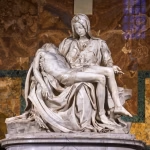
One of the basilica’s most famous works is Michelangelo’s Pietà, sculpted in 1498–1499 when the artist was in his early twenties.
The sculpture depicts Mary holding the body of Jesus after the Crucifixion. It was carved from a single block of Carrara marble and commissioned for a French cardinal’s tomb chapel. It was later placed in St. Peter’s Basilica, where it became one of Michelangelo’s most celebrated works.
Look closely at the contrast between Mary’s calm expression and the lifeless body of Christ. Michelangelo used the smooth surface of the marble, the folds of the clothing and the arrangement of the two figures to create a scene that is both monumental and deeply intimate.
The Pietà is protected behind glass following an attack in 1972. Visitors can still see the sculpture from the viewing area.
The Tomb of St Peter and the Ancient Necropolis
Official history: The Tomb of Saint Peter
Beneath the grandeur of the basilica lies a very different world.
The Vatican Necropolis is an ancient burial area containing tombs and remains from Roman times. It lies below the present church and the Vatican Grottoes, and offers a glimpse of the landscape that existed before the great basilica was built.
What did archaeologists discover?
Excavations carried out between 1939 and 1949 revealed an ancient necropolis beneath St. Peter’s. Archaeologists uncovered tombs, burial structures, inscriptions and a small memorial associated with the traditional tomb of Peter.
The remains showed that this was not originally an empty site waiting for a church. It was a burial ground that had developed on the outskirts of ancient Rome.
One important structure is commonly known as the Trophy of Gaius. It is associated with an early Christian memorial to Peter. The ancient historian Eusebius recorded a reference to memorials of the apostles in Rome, and the archaeological remains helped researchers understand the long history of devotion connected with the site.
A small piece of plaster discovered near the memorial carries Greek letters that have been interpreted as referring to Peter. The reading and meaning of the inscription have been discussed by scholars, so it is best understood as part of the evidence surrounding the traditional tomb rather than a simple, definitive identification.
The excavations strengthened the historical understanding of why Constantine’s basilica was built in this location. The burial site had already become a place of Christian memory long before the great church rose above it.
Can visitors see the tomb?
The traditional tomb of St Peter lies beneath the main altar of the basilica. The area immediately above it is known as the Confessio, which allows visitors to look down towards the sacred site.
The deeper necropolis is a separate visit, with restricted access and advance arrangements required. It is not the same as simply entering the basilica or visiting the Vatican Grottoes.
The distinction matters because these are different archaeological and historical spaces. The grottoes contain later underground areas and tombs, while the necropolis preserves much older Roman burial structures.
For anyone interested in the origins of Christianity in Rome, the underground site offers a rare opportunity to look beneath the Renaissance building and encounter the ancient world that preceded it.
St Peter’s Square: The Architecture of Welcome
Official history: St Peter’s Square
Before entering the basilica, spend time in St. Peter’s Square.
The square was designed by Gian Lorenzo Bernini and completed in 1667. Its two sweeping colonnades form a vast oval space in front of the church. The arrangement was intended to create a monumental approach to the basilica and is often described as resembling open arms.
The colonnades contain 284 columns arranged in four rows, with 140 statues of saints standing above them. From the centre of the square, the repeated columns create a remarkable sense of rhythm and perspective.
At the centre stands an ancient Egyptian obelisk. It was brought to Rome in antiquity and originally stood in the area of the circus associated with Caligula and Nero. It was moved to its present position in 1586, long before Bernini completed the square. A cross stands at its summit.
The obelisk connects several layers of history: ancient Egypt, imperial Rome and the later Christian city. It is one of the clearest examples of how Rome repeatedly adapted monuments from earlier civilisations for new settings and meanings.
Look for the circular markers on the paving that indicate particular viewpoints. From these positions, the rows of columns appear to line up in a way that makes the colonnade seem to have a single row rather than four. This is a clever demonstration of Bernini’s understanding of geometry and perspective.
The square is more than an entrance. It is a carefully planned architectural space designed to bring the basilica into conversation with the city around it.
The Vatican Museums: From Ancient Statues to Renaissance Masterpieces
Official history: The Vatican Museums
The Vatican Museums are not a single museum in the modern sense. They are a collection of galleries, courtyards, archaeological objects, paintings, sculptures and historic rooms accumulated over centuries.
Their history is closely connected with the Renaissance, when ancient Greek and Roman art became a major source of fascination for artists, scholars and collectors.
The beginnings of the sculpture collection are usually traced to 1506, when a group of classical sculptures was assembled in what became known as the Courtyard of the Statues, now the Octagonal Court. Two particularly famous works associated with this early collection are the Apollo Belvedere and the Laocoön.
Over time, the collections expanded to include antiquities, maps, tapestries, paintings and works created for religious and ceremonial spaces. Visitors today pass through galleries that reflect very different periods and artistic traditions.
The Laocoön
The Laocoön is one of the most dramatic sculptures in the Vatican Museums. It depicts a Trojan priest and his two sons caught in the coils of enormous serpents.
In the story from Greek mythology, Laocoön warned the people of Troy not to accept the wooden horse left by the Greeks. The gods who favoured the Greeks sent serpents to attack him and his sons.
The sculpture captures the struggle through twisting bodies, tense muscles and faces expressing pain. It is usually dated to around the first century BC, although the history and dating of the work have been debated.
The group was discovered in Rome in 1506 and quickly became a celebrated example of ancient sculpture. Its influence on Renaissance artists was considerable because it showed how marble could be used to express movement, tension and intense emotion.
When you look at it, notice how the three figures form a single composition. The bodies twist in different directions, yet the serpents connect them into one dramatic scene.
The Apollo Belvedere
The Apollo Belvedere represents the Greek god Apollo. The marble statue is generally understood as a Roman copy of an earlier Greek bronze original.
For centuries, it was admired as an ideal of classical beauty. Renaissance artists and later European scholars studied ancient sculpture in search of proportion, balance and the representation of the human body.
The statue’s importance lies not only in its appearance, but in its influence on the history of art. It helped shape European ideas about classical beauty for generations.
Raphael’s Rooms
Among the Vatican Museums’ greatest treasures are the rooms decorated by Raphael and his workshop between 1508 and 1524.
These rooms were originally part of a residential apartment. Raphael transformed their walls into large painted compositions filled with figures, architecture and scenes drawn from theology, philosophy and history.
The most famous painting is The School of Athens, in the Room of the Segnatura. It brings together great philosophers of the ancient world in an imaginary architectural setting.
At its centre stand Plato and Aristotle. Plato points upwards, traditionally understood as a reference to the world of ideas; Aristotle gestures towards the world around him, associated with observation and practical knowledge.
The figures are not gathered because they lived at the same time. The painting is an artistic vision of the intellectual world, bringing together thinkers from different periods.
Look for the surrounding figures, each absorbed in discussion, writing or contemplation. Raphael created a scene in which knowledge appears as a shared human endeavour.
The room is a reminder that Renaissance culture did not see classical learning and Christian thought as necessarily opposed. Artists and scholars often tried to understand how the inherited wisdom of antiquity could be placed within a wider account of human knowledge.
The Gallery of Maps
One of the most striking corridors in the museums is the Gallery of Maps, a long passage lined with painted maps of the Italian regions.
Created in the late sixteenth century under the direction of the cartographer Ignazio Danti, the gallery contains detailed representations of landscapes, towns, coastlines and territories. The vaulted ceiling is decorated with elaborate paintings.
The maps were not produced with the satellite imagery or precise surveying tools used today. They reflect the geographical knowledge, artistic conventions and political understanding of their time.
Walking through the gallery is like travelling across Italy before the modern nation-state existed. The maps offer a visual record of how people represented the land and understood the places in which they lived.
The Sistine Chapel: Michelangelo’s Painted Bible
Official history: The Sistine Chapel
The Sistine Chapel is one of the most famous rooms in the world. Many visitors arrive knowing the image of God reaching towards Adam, but the ceiling tells a much larger story.
The chapel was restored and decorated in the late fifteenth century. Its wall paintings included scenes from the lives of Moses and Jesus, created by artists including Sandro Botticelli, Pietro Perugino and Domenico Ghirlandaio.
Michelangelo was commissioned to paint the ceiling in 1508. He completed the work in 1512, covering the curved surface with scenes from Genesis, including the Creation, the Fall of humanity and the story of Noah.
The Creation of Adam
The best-known scene shows God reaching towards Adam, whose hand extends towards Him. The fingers do not quite touch.
That small gap has become one of the most recognisable images in Western art. It captures the moment of creation as a meeting between divine power and human life.
Look beyond the hands. The human body is central to Michelangelo’s work, and the figures are painted with a sculptor’s understanding of anatomy, movement and form.
The ceiling contains many other scenes, along with prophets, sibyls and figures from the biblical story. Seen as a whole, it is a carefully organised visual narrative rather than a collection of separate illustrations.
The Last Judgment
More than twenty years later, Michelangelo returned to the chapel to paint the enormous Last Judgment on the altar wall. He worked on it from 1536 to 1541.
The painting depicts Christ at the centre of the final judgement, surrounded by figures rising, falling, pleading and being carried through the scene. Its crowded composition creates a powerful sense of movement.
The work is different in mood from the ceiling. Rather than presenting the ordered story of Creation, it confronts the viewer with the end of human history and the question of judgement.
The chapel’s paintings underwent a major restoration between 1979 and 1999. The restored colours and details have helped viewers better appreciate the complexity of Michelangelo’s work.
When visiting, remember that the chapel is a sacred and historic space. Photography is prohibited inside, and visitors are asked to remain quiet.
The Vatican Gardens: A Different Side of the City
Visitor information: Vatican Museums
After the basilica and museums, the Vatican Gardens offer a different experience.
The gardens occupy a substantial part of Vatican City and contain paths, lawns, fountains, monuments and carefully maintained planting. Their history developed over centuries, and different areas reflect different styles of garden design.
Unlike the basilica and the main museum route, the gardens are generally visited through an organised tour that must be booked in advance.
The atmosphere is quieter than the crowded square and galleries. Visitors can see how landscaping, architecture and sculpture are arranged within a compact city that is both a historic site and a living place.
The gardens are not simply decorative. They form part of the long history of how the Vatican’s grounds were developed and maintained.
How to Plan Your Visit
The basilica, the underground necropolis and the Vatican Museums are separate experiences, so do not assume that one visit or ticket covers everything.
- St Peter’s Basilica: allow time to see the Pietà, the main altar, Bernini’s canopy and the dome. Check the official website for access and opening information.
- Tomb and necropolis: arrange this separately if you want to explore the ancient burial site beneath the basilica. Access is limited.
- Vatican Museums and Sistine Chapel: allow several hours. Decide in advance which collections matter most to you, because the museums are extensive.
- St Peter’s Square: spend time looking at the colonnade, the obelisk and the relationship between the square and the basilica.
- Vatican Gardens: book an authorised tour in advance if you want to visit.
Official visitor information is available through the St Peter’s Basilica website and the Vatican Museums website. Check both before travelling, as opening arrangements, access and booking requirements can change.
A Place Where Many Histories Meet
Vatican City is more than a collection of famous buildings. Its streets, galleries, sculptures and underground tombs preserve traces of ancient Rome, early Christianity and the artistic achievements of the Renaissance.
The tomb traditionally associated with Peter connects visitors to the earliest centuries of Christian history. St. Peter’s Basilica shows how that memory inspired one of the greatest architectural projects in Europe. The Vatican Museums reveal how ancient art and Renaissance creativity shaped the visual culture of the West. The Sistine Chapel brings biblical stories to life on a scale few artists have ever attempted.
Each place has its own story. Together, they form a remarkable journey through faith, art, archaeology and human creativity.
The most rewarding visit is one in which you look beyond the famous photographs and take time to discover what lies behind them: the people who built these places, the ideas they wanted to express and the history that has accumulated in every stone, painting and sculpture.
That is when Vatican City becomes more than a destination. It becomes a window into the long and complicated history of the world that created it.
sources
St Peter’s Basilica. “The Basilica.” Official history of the construction of the present basilica and the architects involved. Read the source.
St Peter’s Basilica. “The Tomb of Saint Peter.” Background on the ancient burial site, the Trophy of Gaius and the archaeological excavations of 1939–1949. Read the source.
Peter’s Basilica. “The Dome.” History of Michelangelo’s design and the dome’s completion in 1590. Read the source.
St Peter’s Basilica. “The Pietà of Saint Peter’s.” History of Michelangelo’s sculpture, its commission and its creation in 1498–1499. Read the source.
St Peter’s Basilica. “The Square.” History and design of Bernini’s colonnade and the central obelisk. Read the source.
Vatican Museums. “History.” Background on the development of the museum collections. Read the source.
Vatican Museums. “Laocoön.” History and interpretation of the ancient sculpture. Read the source.
Vatican Museums. “Raphael’s Rooms.” History of the rooms and their painted decoration. Read the source.
Vatican Museums. “Sistine Chapel.” Official account of the chapel’s decoration, Michelangelo’s ceiling and The Last Judgment. Read the source.



Leave a Reply